The Sunday Times shines a spotlight on our campaign

National Spotlight Falls on Tite Street’s Fight for Its Future

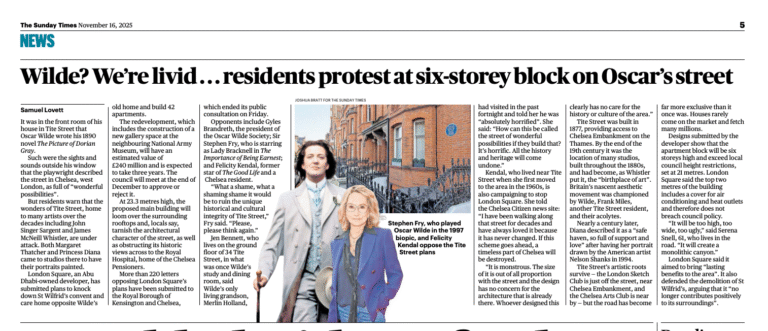
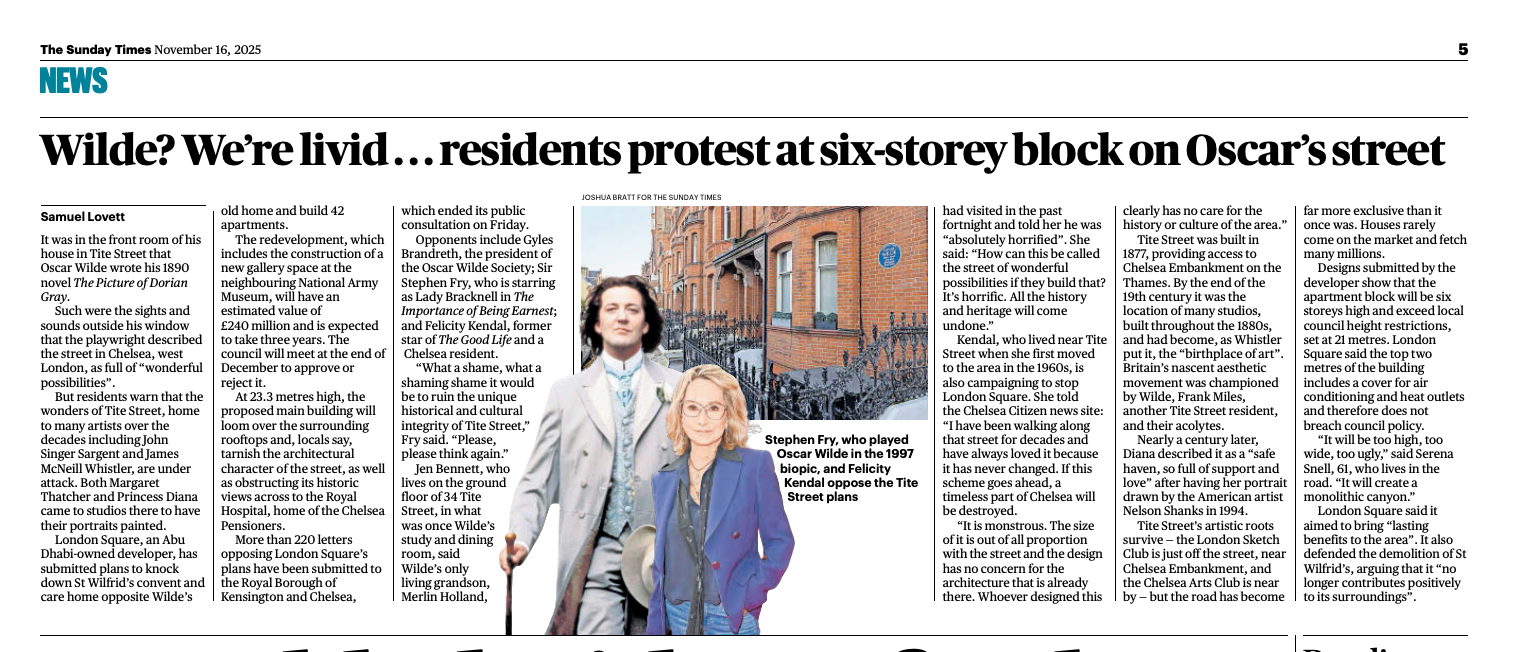
The Friends of Tite Street were delighted to see the Sunday Times shine a bright national light on the sheer excess of the scheme proposed by London Square. The piece captured what local residents have been saying for months: that a over-sized block on one of Chelsea’s most historic streets is an act of architectural overreach and vandalism. See it the cutting here or visit online article here (note that The Sunday Times is behind a paywall).

Gyles Brandreth, Stephen Fry and Felicity Kendal all added their voices to the general dismay – underscoring the culture and heritage at risk. Their comments conveyed a shared truth, that this proposal is not merely too big, but tone-deaf to the charm, scale and heritage that define Oscar Wilde’s old neighbourhood.

London Square’s reply, a familiar blend of platitudes and process, failed to address the central issue. That Chelsea deserves better than an oversized, ill-fitting slab on a street renowned for its grace and history. The Friends of Tite Street will continue to press for development that respects, rather than diminishes, this remarkable corner of London.

Parish Magazine Highlights Local Concerns over St Wilfrid’s

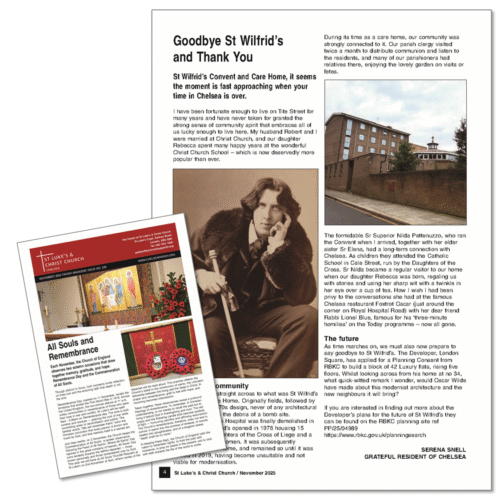
Screenshot of the November edition of St Luke's and Christ Church Parish Magazine
St Luke's & Christ Church Parish Magazine highlighted the plans to redevelop Tite Street in their November edition

Long-standing resident Serena Snell sets out why the community is worried about London Square’s plans

We were pleased to see Serena Snell, one of Tite Street’s long-standing residents, featured in this month’s St Luke’s and Christ Church parish magazine. Her piece offered a thoughtful and personal account of St Wilfrid’s Convent and Care Home and its place in the life of our community. Few know the history of the site, or its connection to Chelsea’s religious and social fabric, better than Serena, who has lived on Tite Street for many years and remains a passionate defender of its character.

Her reflections also underscored why so many local residents are concerned about the scale of the redevelopment proposed by London Square. A five-storey block of 42 luxury flats would be a stark departure from the modest architecture that has defined this corner of Chelsea for generations. Serena’s voice adds to the growing chorus of those calling for a scheme that honours both the history of St Wilfrid’s and the distinctive charm of Oscar Wilde’s old street.

You can download the November edition of the parish magazine here.

London Square’s Plans: When Heritage Pays the Price

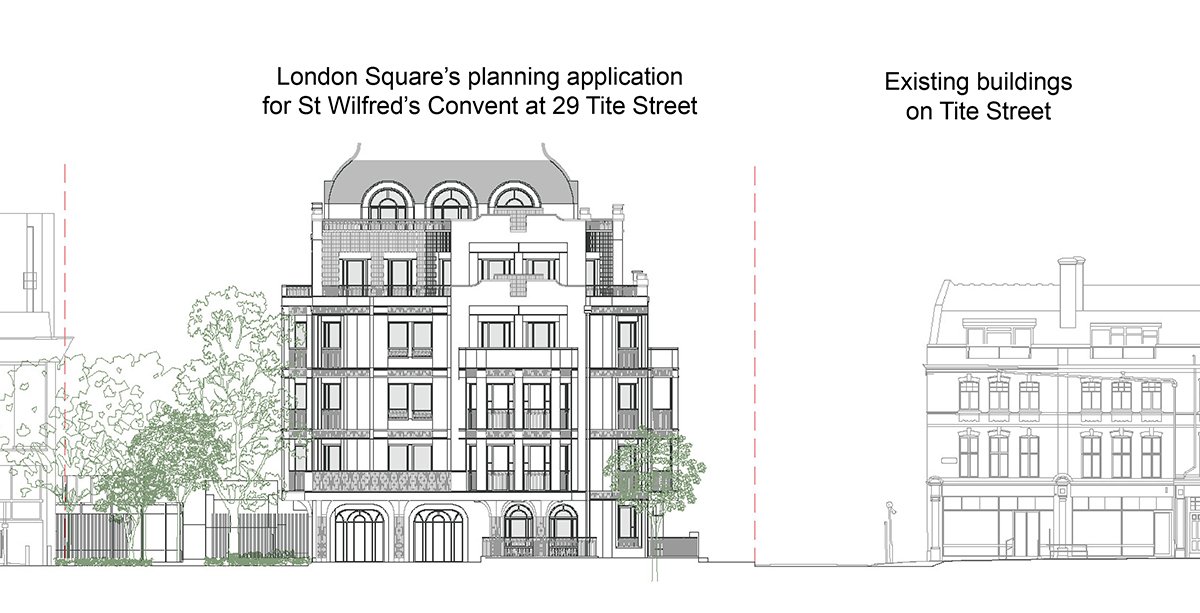
View of London Square’s plans from Royal Hospital Road looking south east.

London Square’s £240 million scheme would demolish St Wilfrid’s Convent for 42 luxury flats – but its core planning failings remain unchanged.

London Square is proposing the demolition of the former St Wilfrid’s Convent and care home at 29 Tite Street, replacing it with a development of 42 new homes (known in planning terms as Use Class C3, meaning private residential housing) within a new building rising to six storeys above ground, and stretching two storeys below it.

The Friends of Tite Street has examined the application carefully, and despite nearly two years of engagement with the developer, the three principal failings we identified at the outset remain entirely unaddressed.

First, the building is simply too tall and too bulky for this narrow, historic street. At six storeys plus plant rooms it rises to 23.35 metres (that’s 76.6ft) at its highest point. That is nearly a whole extra storey above the Borough’s own policy limit of 21 metres for residential development in this area.

These plans would overwhelm Royal Hospital Road, create a canyon effect on Tite Street, dominate the listed artists’ studios opposite and destroy the human scale that gives this part of Chelsea its character. The building would darken the street and erase the rhythm of light and space that defines its charm.

Second, the design builds directly across two protected “townscape gaps”. First, the open garden and the former chapel at the south end, and second the northern break next to Royal Hospital Road. These are not incidental spaces, but deliberate features identified in the Royal Hospital Conservation Area Appraisal – the visual breathing room that lets the street’s distinctive architecture sing.

Third, the proposed façade bears no relationship to the architectural variety of Tite Street. Where Godwin’s Arts & Crafts houses dance with gables and asymmetry. London Square’s design is monolithic, top-heavy and horizontal, importing alien motifs – like its repetitive horizontal bands – are not an authentic reflection of the street’s historic design language.

Compounding these failings, the scheme removes a protected care-home use without replacement and provides no affordable housing whatsoever – a remarkable omission for a development of this scale.

Underlying all of this is the uncomfortable truth: London Square – which is now wholly owned by Aldar Properties, listed on the Abu Dhabi Securities Exchange, with the United Arab Emirates’ sovereign wealth fund as its largest shareholder – overpaid for the site and is now seeking to recover that cost in floor area rather than design quality. The result is a proposal driven by financial expedience, not by planning policy or respect for place.

For a council that calls itself “fiercely proud of its cultural heritage,” this is a moment for the Royal Borough of Kensington & Chelsea to stand firm. The Friends of Tite Street are not opposed to renewal – only to overdevelopment. A sensitive, policy-compliant scheme could bring life back to the site without disfiguring Chelsea’s most historic street. London Square has had every opportunity to deliver such a design. It has not done so.

Who’s behind London Square’s plans?

Meet Aldar – the Abu Dhabi property giant that overpaid for Tite Street and is now trying to build its way out of a bad deal.

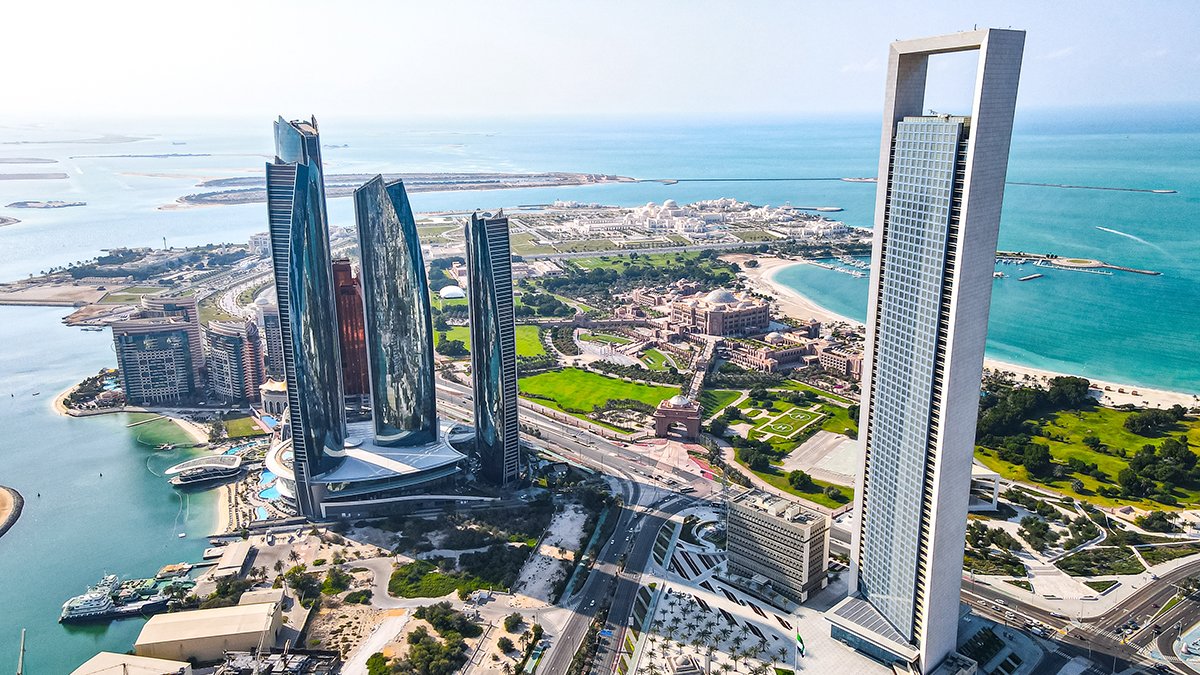
In 2023, London Square was acquired by the Abu Dhabi-based Aldar Group – a vast real estate conglomerate, which is listed on the Abu Dhabi Securities Exchange  (Ticker: ALDAR:UH), with the United Arab Emirates’ sovereign wealth fund as its largest shareholder. It has access to virtually limitless capital – much of it now directed towards its growing London development programme.

That buying power allows London Square to outbid competitors, even when the price defies market logic. This is exactly what happened at Tite Street: Aldar paid a premium that simply cannot be justified by current market conditions. The result is a scheme driven not by place, history or proportion, but by the need to claw back an overpayment.

London Square’s plans reflect this imbalance. Instead of a sensitive renewal that complements the extraordinary artistic and architectural character of Oscar Wilde’s “Street of Wonderful Possibilities”, they propose an oversized, overbearing block that would suffocate the very qualities that make the site special.

To justify it, London Square and Aldar have conjured a kind of phantom debate. In their planning documents and letters to residents, they give the impression of having “compromised” – as though shaving a little height here or softening a corner there might somehow balance the harm elsewhere. It’s a curious logic: we’re going to break the planning rules, just not quite as badly as we first intended – isn’t that fair enough?

Of course, this is a smokescreen for a much simpler calculation: profit set against place. The planning rules are perfectly clear – both scale and setting must be respected. You cannot claim to preserve a conservation area while chiselling away at the very qualities that make it one. That is no respect at all.

The tragedy is that few companies are as well-resourced as Aldar – and few sites demand greater restraint or imagination. Aldar could afford to champion design excellence and cultural sensitivity; instead, its approach feels tone-deaf to one of Britain’s most storied streets.

On its glossy website, London Square declares: “Wherever the location of a London Square development is, we strive to be a central pillar of the local community.” This is not what they are doing in Tite Street.

Two Guardians, One Story to Protect

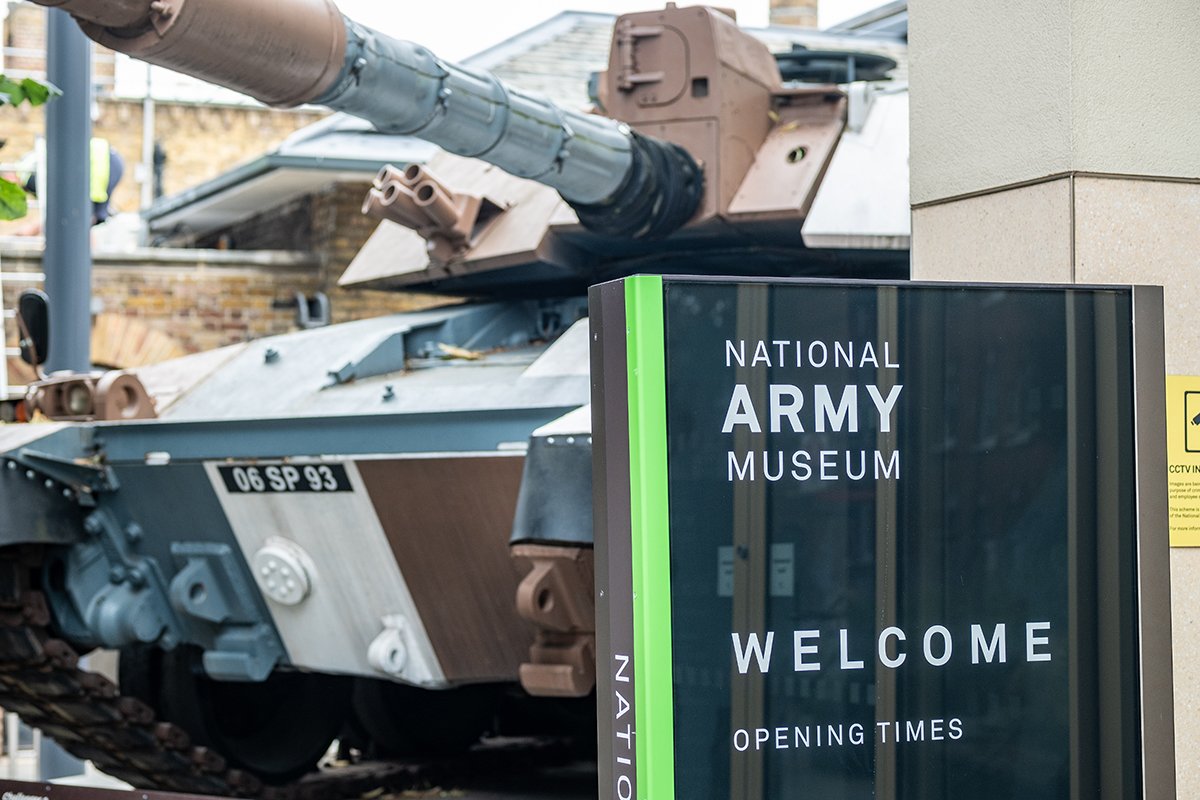
Image by William - stock.adobe.com

The National Army Museum preserves our national history; the Friends of Tite Street safeguard its cultural soul. Both deserve room to breathe.

The National Army Museum is one of the crown jewels of Chelsea – a thoughtful custodian of Britain’s military story. Founded at Sandhurst and moved to its current home beside the Royal Hospital in 1971, it stands as a tribute to service, duty, and tradition. Inside, visitors walk through centuries of courage and complexity, told with care and dignity.

Just around the corner lies another form of history – quieter, perhaps, but no less significant. Tite Street is where art and literature, wit, and rebellion once reshaped Britain’s cultural identity. Wilde, Whistler, and Sargent lived and worked here, giving Chelsea its place not just on the map, but in the national imagination.

The Friends of Tite Street, in our modest way, try to do for this cultural heritage what the Museum does for our military one: to keep it alive, understood, and worthy of respect. Both stories – martial and artistic – are chapters in the same national narrative. Each deserves protection not only for what it preserves, but for the surroundings that give it resonance.

It is easy to see why the National Army Museum wishes to improve its facilities; its ambitions are admirable, and we support them wholeheartedly. The Museum deserves its new gallery – but not at the cost of erasing the heritage that gives its setting meaning. Is that really a price worth paying?

That price should not fall on Chelsea’s history. Aldar Properties – which is listed on the Abu Dhabi Securities Exchange, with the United Arab Emirates’ sovereign wealth fund as its largest shareholder – has the means to pay it. Instead, through its UK arm, London Square, it is asking the street and the borough to absorb the cost of a misjudged overpayment for the site.

The Royal Borough of Kensington and Chelsea also has a choice to make. It calls itself a guardian of heritage and culture – and rightly so. That guardianship means standing firm when global capital seeks to build its balance sheet at the expense of local character.

With a little restraint and imagination, everyone could win: the Museum could flourish, the street could breathe, and Chelsea could remain the living tapestry of history it has always been.