Article by Rob McGibbon | Nov 11, 2025 | from The Chelsea Citizen
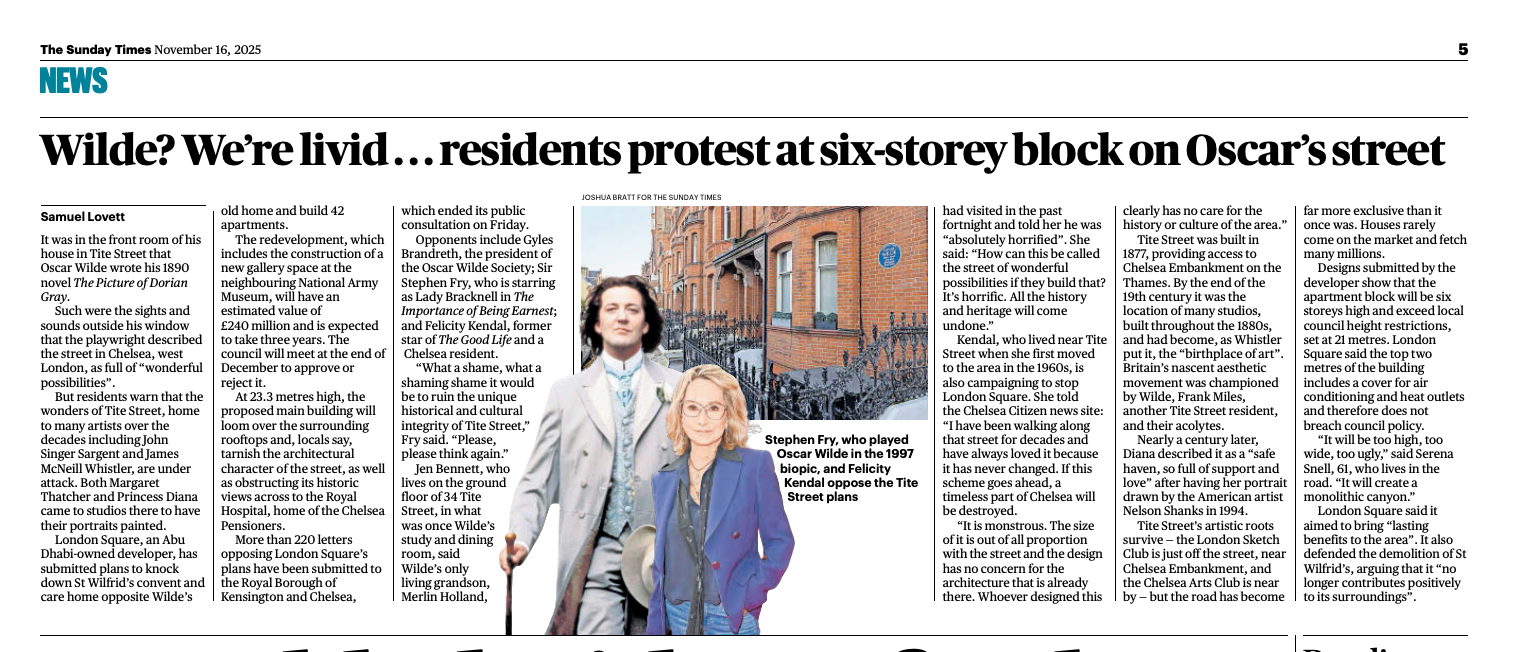
A furious battle has broken out to stop a large-scale development of luxury apartments that will “vandalise” one of Chelsea’s most celebrated historic streets.
A determined legion of residents and local groups have parked their tanks on the lawns of developer London Square and the National Army Museum (NAM) in opposition to an estimated £240m joint venture that – if approved – will totally transform Tite Street in SW3.
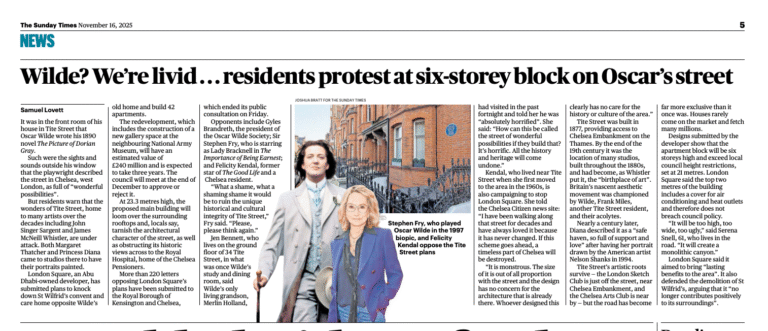
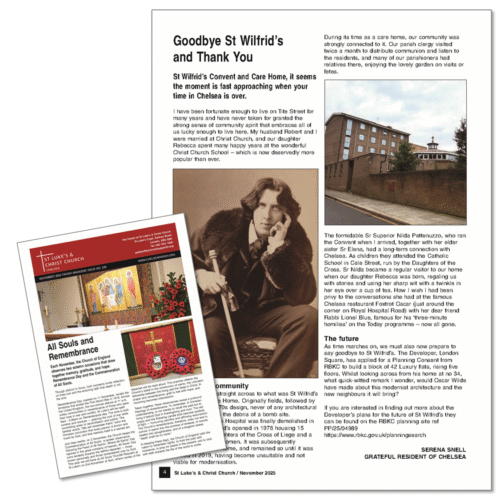
Tite Street is a much-loved corner of Chelsea, thanks to its rich cultural history, its remarkable artists’ studios and its collection of Blue Plaque properties. Oscar Wilde lived there, as did iconic painters James Whistler and John Singer Sargent. The presence of such creative luminaries helped establish the area as a beacon of artistic Chelsea during the19th century. Wilde once described Tite Street as “The street of wonderful possibilities”.
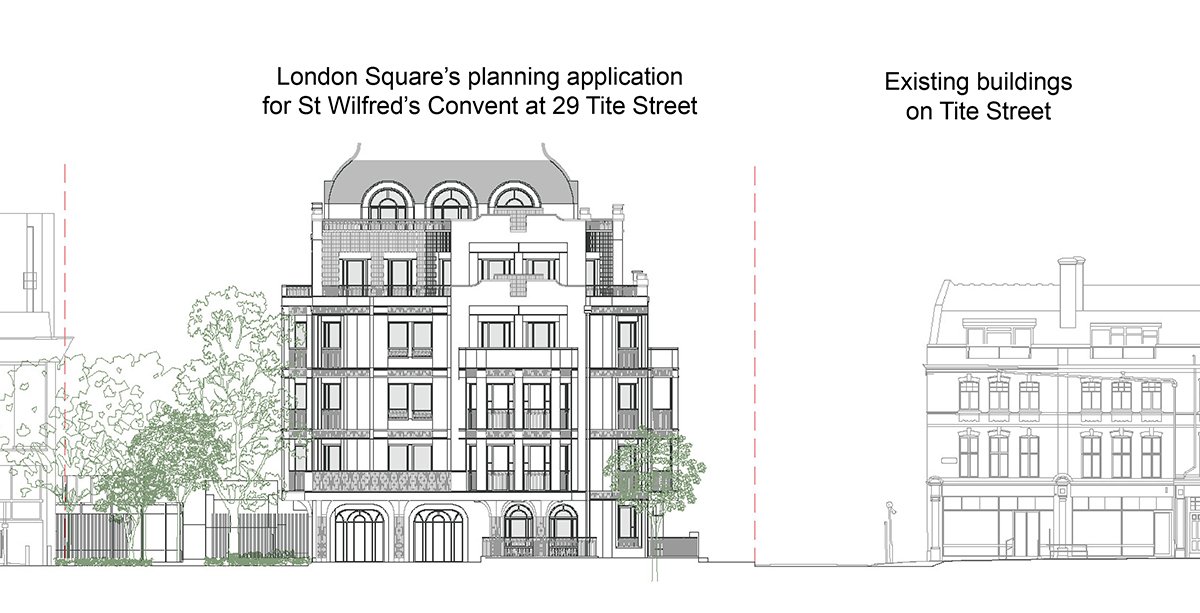
If London Square and NAM gain approval for their development, the Tite Street canvas will carry a dramatically different image. In a planning application filed with RBKC council, the developers have outlined plans to demolish the disused St Wilfrid’s Convent and replace the entire length of the existing building’s footprint of some 3,000 sq/m, as well as its garden, with a mansion block-style of flats. This will rise to six storeys (23.3m / 76.6ft) and will comprise of 42 one-to-three bedroom “family homes”.
As part of the development, the NAM’s underground car park will be transformed into a new exhibition space. Sitting on top of that will be a new garden for visitors, to be created by award-winning garden designer Andy Sturgeon. The development could take up to three years to complete. If, as proposed, works start next summer, it would be completed “some time” during 2029.
‘If this goes ahead, it will be nothing short of architectural and historical vandalism,’ raged one local resident to The Citizen. ‘This scheme is a disaster on so many levels. It will entirely disfigure and wreck this important street, which is why it should be dismissed outright by the council. If the developers are serious about building here, they need to go back to the drawing board and come up with something else.’
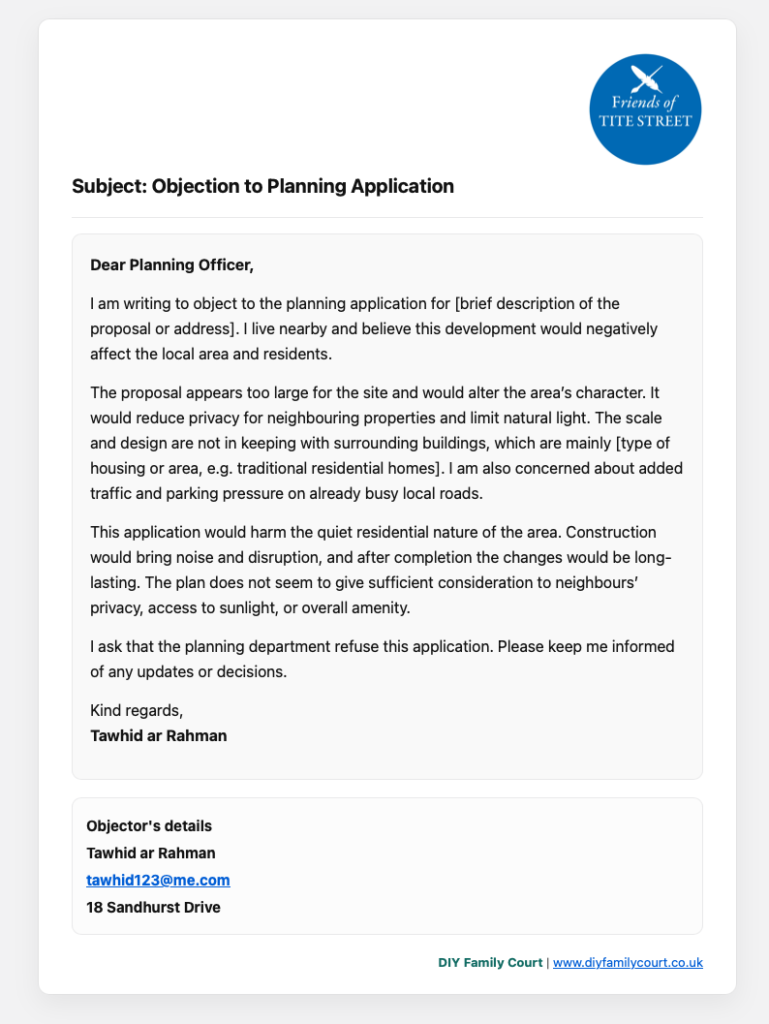
Residents and campaigners have dug in for a long fight by launching a dedicated website entitled Friends of Tite Street. In a series of articles on the site, its creators have drawn attention to various aspects of London Square’s plan that they oppose. Key parts to the objections are:
- The scale and “massing” of the building
- The design of the block, which they say does not chime with the arts and crafts heritage of other significant buildings, as created by the revered 19th century English architect Edward Godwin
- The prized “townscape gaps” that currently exist will be obliterated by over-bearing high buildings that will lead to the loss of light and destroy the outlook from properties on the west side of the street
- The scheme does not provide any social housing or care facilities in compensation for the loss of St Wilfrid’s, nor is there any significant Section 106 compensation off-set in the scheme for RBKC council
- The development flies in the face of restrictions already in RBKC’s Local Plan, such as the stipulation that heights of new builds should not exceed 21 metres
- The small garden facing Royal Hospital Road will be lost in the development and only a small section of the garden to the south of St Wilfrid’s will survive – where it butts up to the grand studio home once inhabited by Sargent.
Residents told The Citizen that they enthusiastically took part in consultation events and various workshops with London Square during the past two years to provide extensive suggestions as to how the scheme could be improved. They accept that it’s best for St Wilfrid’s to be re-developed – and they wholly support an expansion of the Army Museum – but residents say that they now feel exasperated that precious little of their feedback was taken on board.
‘We don’t feel that we have been listened to at all,’ said one Tite Street homeowner. ‘The developer knows exactly why we are opposed to this building, yet it has ploughed on and submitted a planning application regardless. The key things that we deplore are still in the plans. The changes they have made are cosmetic when put into the context of the overall impact of this plan. They seem to be tone death. Now the gloves are off and we are ready to fight every aspect of this appalling development until it is dead in the water.’
In a statement, London Square hit back and claims that it has taken on board feedback from residents and amended the scheme “significantly”. It says that it held three large scale community consultation meetings and six smaller discussion groups with the Tite Street residents.
It says that it has “revised the massing”, lowered the main building from seven storeys to six, and reduced the scale by introducing a town house at the southern end of the area. The company has loaded a video to its website that illustrates the changes to the scheme from July 2024 to September 2025.
London Square was acquired for £230m in 2023 by Aldar, the Abu Dhabi-based real estate investment giant that is backed by the country’s sovereign fund. The St Wilfrid’s site was bought for £54m in March 2024 and is now one of Aldar and London Square’s flagship UK projects.
One influential property manager with expert knowledge of the area, believes that London Square overpaid for the site and estimates that its real value should have been £25-30m. He says that the GDV (Gross Development Value) is driving the scale of the project. He said: ‘Basically, they have overpaid and now they’re having to overbuild to make the numbers work. London Square has not altered the basic design since the consultation period because that affects the bottom line. If they reduce height and massing, they lose money, and the project does not make a return on its investment.’
The Citizen has heard that campaigners are considering taking their case direct to the ultimate owners of London Square in Abu Dhabi in the hope of high level intervention similar to the one that King Charles orchestrated in 2009 when he told the emir of Qatar that he was vehemently against the design for the redevelopment of Chelsea barracks. That led to the sudden abandonment of the scheme, which at the time was led by the Candy Brothers and the late architect Richard Rogers. Court action followed.
‘Going to the Abu Dhabi owners is the nuclear option,’ set one campaigner. ‘But we are curious to know if the powers-that-be in the Middle East actually know what London Square is doing with this project. Do they really want to be associated with this kind of architectural vandalism of a significant area of London? We very much doubt it.’
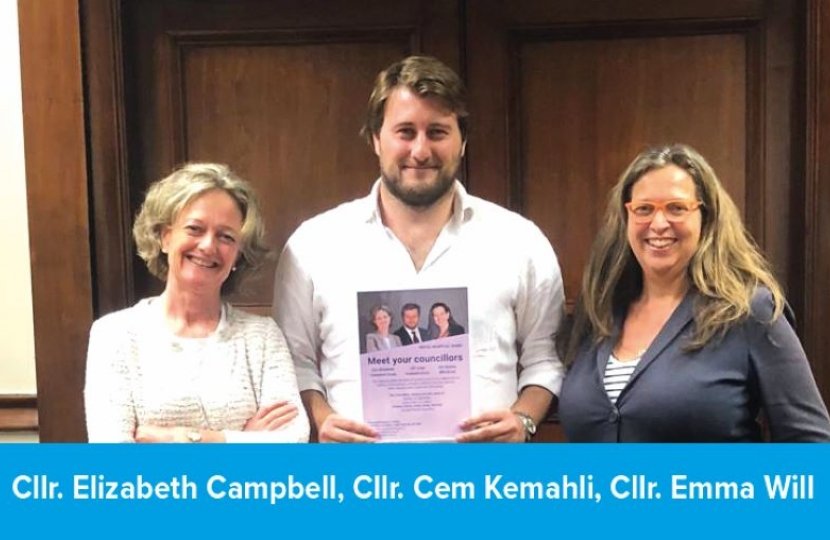
Since London Square lodged its official application in September, RBKC’s planning portal has received (at the time of publication) 117 objections, compared to six notes of support and four neutral. The Citizen understands that the local ward councillors for Royal Hospital Ward will be objecting to the scheme.
John Thalassites, RBKC’s lead member for environment and planning, said in a statement: ‘We have received a planning application for a redevelopment on Tite Street. I am aware of the strong resident feeling on this application, and I have met Tite Street residents – with Cllr Emma Will – to discuss the scheme in the past few months. I would encourage local people to have their say during consultation. I want to see development that enhances this special part of Chelsea and will work with residents and applicants to achieve that.’
The Chelsea Society has been in close contact with residents since the development first came on the radar and was highly active during the consultation meetings. In a damning rebuke on its website, the Chelsea Society states of London Square: ‘Their final plans show little change from the previous version which we saw and do not, in our view, pay sufficient attention to the pre-planning advice which they have received from Council officers.
‘They are not, for example, proposing to include any element of care provision or other community use in their scheme nor are they offering any on-site affordable housing. These were all issues highlighted by Council officers in their previous consultations with London Square and it is disappointing that they have been ignored. While we support the provision of extra exhibition space for the National Army Museum which London Square are proposing to build, we do not think that this should involve the sacrifice of other local community facilities.
‘The building’s design also fails to reflect Council officers’ advice. It is higher than would normally be permitted in an area of this kind and it envisages the retention of only part of the vitally important garden and townscape gaps. Tite Street is one of the most iconic streets in Chelsea with a rich artistic and historical heritage. We hope therefore that in assessing this application RBKC will be scrupulous in applying its own policies and will demand the necessary changes to it.’
The Cheyne Walk Trust is preparing an objection statement, as is the Lots Road Neighbourhood Forum. Its chairman, Richard Jacques, said: ‘This is yet another example of a developer riding roughshod over previous advice and guidelines in pursuit of overdevelopment. The building is too tall and too monolithic, and will result in the canyonisation of Tite Street. Moreover, the scheme has no element of care provision, little or no community use and no on-site affordable housing, leaving developments in other parts of the borough to bear the burden of this provision.’
American Lee Muller, who has lived in Tite Street for two years and loves the area, said: ‘This is a monstrous development that will overwhelm and completely alter the historic character of this street. If the residents are expected to support it, then the design must change dramatically.’
One resident who lives directly opposite the “light gap” added: ‘Our home will go from having an uninterrupted view of the sky and of Sir Christopher Wren’s Royal Hospital, to a massive red brick building with the balconies and windows from flats looking directly into our living room. The whole project is an appalling prospect. We all accept that St Wilfrid’s is ugly and run down and some kind of development should take place here, but we’d far rather live with that old mess than this disaster.’
Tite Street was first established in 1877 and became synonymous with artists. Painter James McNeil Whistler was an early inhabitant and built what he called The White House there, although his property has long-since been demolished. Tite Street is known for fabulous studio houses, such as Singer’s and the one at No.44, which was designed by renowned architect Godwin. A simple one-bed flat in the street costs £700,000 and the most significant houses are worth in excess of £30m.
In an official statement, The Tite Street Association said: “The proposal for St Wilfrid’s would destroy the character of one of London’s most distinctive historic streets – a place where art, architecture and community have coexisted for more than a century. London Square replaces a varied and finally detailed roofline with a monolithic block that ignores the character of Chelsea’s conservation area.
‘It would fill important townscape gaps, canyonising the street and overwhelming its human scale. We are not opposed to development, but it must enhance, not erase, what makes this street special. It is deeply disappointing that London Square – one of the few developers with the resources and reputation to do this properly – has got it so wrong. What drives this scheme is not respect for place or heritage, but the pressure to justify an inflated land deal. Chelsea. deserves better.’
Mark Smith, Development Director for London Square, said in a statement issued to The Citizen: ‘We have always understood the importance of this prominent site, not only for its location in the Royal Hospital Conservation Area but also for the rich heritage and quality of architecture found in Tite Street. Our design team has spent over a year meeting with near neighbours, local stakeholders and the Council to inform the plans. These meetings, visits to neighbours’ homes and the wider community consultation have all been invaluable for our team to listen , learn and respond to feedback.
‘We greatly appreciate the time invested by everyone in this process which, we believe, has created a beautiful scheme complementing the street’s rich architecture and that can bring considerable benefits to the area. The submitted planning application documents reflect the level of detail, thought and consideration that has been gone into this very unique site.’
Justin Maciejewski, Director of the National Army Museum, commented: ‘Our mission is to engage and inspire people with the stories of our Army and our soldiers, creating understanding of their vital role locally, nationally, and globally. In today’s world, our mission is more important than ever.
‘This proposal is a once in a lifetime opportunity to transform our offer, doubling capacity for learning and engagement, creating 40% more gallery space for values-based storytelling with a global reach, and fulfilling the work that was begun when we first came to Chelsea in 1970. We appreciate all the support we have received from so many in our local community over the years and for our plans to extend the museum.’
Comments to RBKC’s planning portal about this scheme are due to close on 14th November, but The Citizen understands that the council is obliged to take all comments into consideration right up until the day that the Planning Committee. After the deadline, interested parties can email views – quoting reference PP/25/04989 – to: planning@rbkc.gov.uk.